Home backup fit
Oxseryn EDOG10 4400W Inverter for Home Backup: What It Can Realistically Cover
Evaluate the Oxseryn EDOG10 4400W Inverter for home backup, including realistic essential loads, output headroom, connection planning, fuel, and safety.
As an Amazon Associate we earn from qualifying purchases. We do not copy Amazon pricing into this article because price and availability change.
Direct answer
The Oxseryn EDOG10 4400W Inverter is best treated as selected-circuit backup rather than unrestricted whole-home power. It is not permission to run every circuit at once; the real answer depends on the appliance list, startup loads, outlet or transfer-equipment plan, and fuel strategy.
Running output
3,400W
Peak output
4,400W
Published weight
56 lb
Class score
54/100
Home-backup verdict
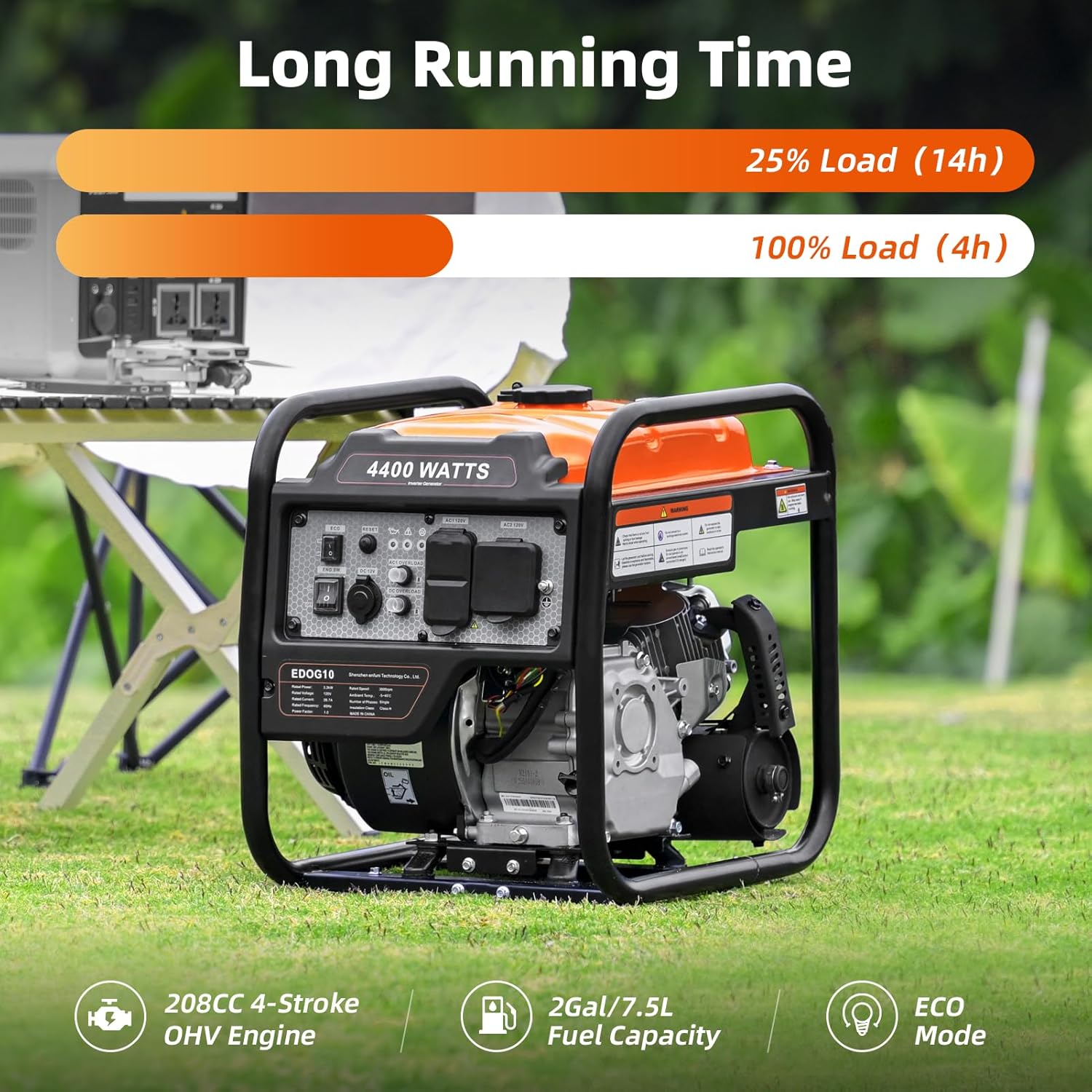
The Oxseryn EDOG10 4400W Inverter is best treated as selected-circuit backup rather than unrestricted whole-home power. Its 3,400 running watts define the continuous budget; 4,400 peak watts provide temporary startup room. That can be useful for essentials, but it is not the same as supplying every circuit with normal utility-power habits.
A credible plan names the circuits, calculates simultaneous demand, identifies the largest motor surge, leaves operating headroom, and states which loads will be staggered. If the plan begins and ends with “whole house,” it is not specific enough to buy safely.
Create an essential-circuits plan
Prioritize safety, health, food preservation, plumbing, communications, and climate protection. A refrigerator, freezer, selected lights, internet equipment, furnace blower, sump pump, or well pump can be more valuable than trying to keep every convenience load available at once.
Use about 2,700 watts as a conservative continuous planning ceiling until exact loads prove otherwise. Large motors and compressors need separate startup checks, and the final result must stay within every outlet, cord, breaker, and generator rating.
Transfer equipment and voltage come before checkout
If the generator will feed household wiring, confirm the exact voltage and receptacle needed by the transfer switch or listed interlock arrangement. The generator manual, transfer equipment, inlet, cable, overcurrent protection, neutral treatment, grounding instructions, and local rules must work as one system.
A licensed electrician can evaluate those pieces and the panel load. Never plug a generator into a household wall outlet. Backfeeding can energize utility lines and expose workers, neighbors, and occupants to lethal voltage.
Fuel, placement and overnight operation
Gasoline keeps the operating plan straightforward, but it also makes fuel storage, rotation, and outage availability part of the buying decision.
Fuel-burning generators belong outdoors, at least 20 feet from the home, with exhaust directed away. Plan weather protection that follows the manual, cord routing, refueling shutdown and cooling time, theft resistance, carbon-monoxide alarms, and who will operate the system at night. A dependable, directly comparable sound figure is not present in the normalized record. Buyers who care about campsite or neighborhood noise should verify the exact test distance and load condition in the manufacturer material before ordering.
When a different solution is better
Choose a larger or professionally installed system if you need automatic operation, multiple large electric heating loads, central air without verified soft-start compatibility, or normal whole-home consumption without load management. Choose a smaller inverter generator when portability, fuel use at light load, and neighborhood noise matter more than maximum output.
Compare the Oxseryn EDOG10 4400W Inverter against ECHO EGi-4000, RYOBI RYi4000, RYOBI RYi4022X before buying. The right alternative is the one that improves the constraint your plan actually has—not simply the model with the next-highest peak-watt number.
Closest catalog alternatives
Three similar generators worth comparing.
ECHO
EGi-4000
3,400W running · 4,000W peak · Gasoline
Inspect modelRYOBI
RYi4000
3,400W running · 4,000W peak · Gasoline
Inspect modelRYOBI
RYi4022X
3,400W running · 4,000W peak · Gasoline
Inspect modelQuick answers
Oxseryn EDOG10 4400W Inverter FAQ
How many running watts does the Oxseryn EDOG10 4400W Inverter provide?
3,400 running watts are listed in the normalized catalog. The model also lists 4,400 peak watts for temporary startup demand.
What fuel does the Oxseryn EDOG10 4400W Inverter use?
Gasoline. When multiple fuels are supported, verify the separate output and runtime figures for the fuel you plan to use.
Can the Oxseryn EDOG10 4400W Inverter power an entire house?
It is best treated as selected-circuit backup rather than unrestricted whole-home power. “Entire house” is not a usable load calculation; list the circuits and startup loads and have household connections evaluated by a qualified electrician.
Sources and method
Check the evidence behind the analysis.
Continue this model research